
 0
0



- Home
- Knowledge
- Screen Printing Process
- Screen Making Guide: Critical Details for Flawless Screen Printing
Screen Making Guide: Critical Details for Flawless Screen Printing
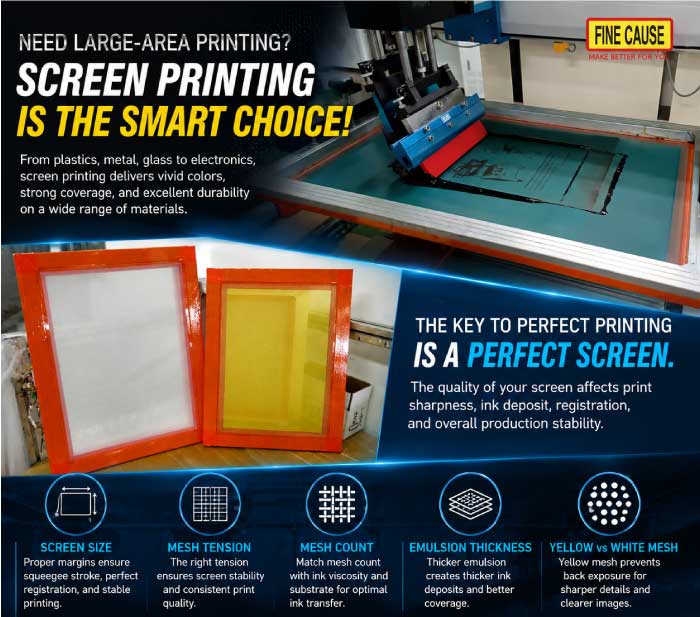
Need large-area printing? Screen printing could be the smart choice.
From plastics and metals to glass, electronics, and more, screen printing remains one of the most versatile printing processes for achieving strong coverage, vivid colors, and reliable results.
But here's the key:
Great screen printing doesn't start with the machine alone. It starts with the screen.
When preparing screen stencils for screen printing, the manufacturing quality of the screen directly determines the precision and edge sharpness of your final prints. Whether it is screen size, mesh tension, emulsion film thickness, mesh color, or mesh count, every detail must strictly adhere to industrial standards. Below is an expert guide to mastering the essential details of screen making:
1. Golden Rules for Screen Size Configuration (Excluding Frame)
A screen that is too small causes uneven tension and image distortion, while an oversized one wastes ink. Configure your screen dimensions based on these three production methods:
- Manual Printing (Hand Print): The screen dimensions should extend approximately 5 cm beyond the upper, lower, left, and right borders of the artwork.
- Semi-Automated Mechanical Printing: To allow sufficient stroke distance for the squeegee and flood bar, add at least 10 cm on both the left and right sides (the squeegee travel direction), and 5 cm on the top and bottom.
- FINE CAUSE New Generation Servo Screen Printers: To achieve absolute micro-registration accuracy and high-speed stability, it is highly recommended to leave 14 cm of clearance on both the left and right sides.
👉 Discover FINE CAUSE New Generation Servo Screen Printer Series
2. Mesh Material and Tension Control (Unit: Newton / N)
The mesh material determines the screen's elasticity and mechanical stability. Choose your mesh type according to the geometric nature of the substrates:
- Nylon Mesh: Exceptional Elasticity for Contoured Surfaces
Tension is generally maintained between 0 to 3 Newtons (N). Lower tension provides greater elasticity and softness, making it perfect for printing on contoured, uneven substrates or for specialized custom-shaped frames. Additionally, its natural flexibility prevents the screen mesh from being easily scratched under squeegee pressure. - Polyester (Tetoron) Mesh: High Dimensional Stability for Precision Work
Tension is typically calibrated between 12 to 14 Newtons (N). Polyester mesh is significantly harder and offers minimal stretch, making it ideal for flat surface applications or high-tech products demanding rigorous multi-color registration accuracy. A higher tension allows a closer off-contact distance between the screen and substrate; conversely, a lower tension requires a larger gap. Standard off-contact distance is recommended between 2 to 4 mm.
3. Screen Emulsion Film Thickness Control
- The emulsion film thickness directly controls the deposit volume and thickness of the printed ink layer. The industrial baseline for standard stencil making is 10 µm. Thicker emulsion coatings produce a heavier, more solid ink deposit.
- While squeegee durometer (hardness) and the angle of the print stroke micro-adjust the ink deposit, their impact is secondary compared to the structural film thickness of the screen stencil.
4. The Science of Mesh Color: Yellow Mesh vs. White Mesh
During the screen exposure stage, the optical properties of the mesh color heavily impact image definition and line sharpness:
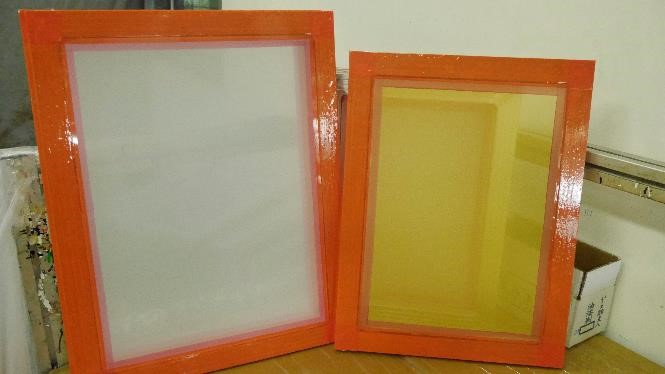
- Yellow Mesh: The Standard for Fine Lines and High-Resolution Stencils
Screen exposure relies on ultraviolet (UV) light, which consists of cyan and red wavelengths. Yellow mesh absorbs these specific actinic wave bands, canceling out scattering light. Consequently, yellow mesh completely eliminates the "back-exposure" phenomenon, yielding maximum image clarity, razor-sharp micro-text, and zero vignetting. - White Mesh: Vulnerable to Secondary Light Scattering
When UV light passes through the transparent areas of the film positive, it hits the surfaces of the white threads. This causes heavy reflection, refraction, and slow diffusion within the core or bottom of the emulsion layer. This secondary "back-exposure" triggers light halation (ghosting), which compromises tone reproduction and fine detail sharpness.
5. Optimizing Mesh Count Based on Substrate Absorbency
Mesh count defines the number of threads per inch, determining the ink flow and deposit rate:
- Lower Mesh Counts (Large Mesh Openings): Highly suited for absorbent materials such as textiles, coarse paper, and unglazed ceramics. The larger mesh openings facilitate a rapid ink flow rate, making them ideal for high-viscosity, heavy-opacity inks and coatings.
- Higher Mesh Counts (Small Mesh Openings): The global benchmark for standard text, fine lines, and graphics on plastics, metals, or electronic components is 300 mesh. The tightly woven mesh features smaller openings, resulting in a controlled, slower ink delivery that pairs perfectly with lower-viscosity, fine-particle industrial inks.
Professional Stencil Making & Custom Screen Printer Upgrades
Achieving flawless prints requires a high-precision screen stencil paired with state-of-the-art machinery. FINE CAUSE provides turnkey precision screen making and smart automation solutions


Article Classification
Recent Articles
- Curved Screen Printer Setup Part 3: Range & Printing
- Curved Screen Printer Setup Tutorial Part 2: Squeegee & Ink Blade Tuning
- Curved Screen Printer Setup Tutorial Part 1: Jig & Stencil Alignment
- Manual 4 Color Screen Printing Machine (T-shirt printing machine) Assembly/Printing Tutorial
- Screen Making Guide: Critical Details for Flawless Screen Printing