
 0
0



Printing Technology
Printing process and teaching related
- Home
- Knowledge
- Consumables Application
- Specifications and Effects of Various Solvents
Specifications and Effects of Various Solvents
July 17,2026
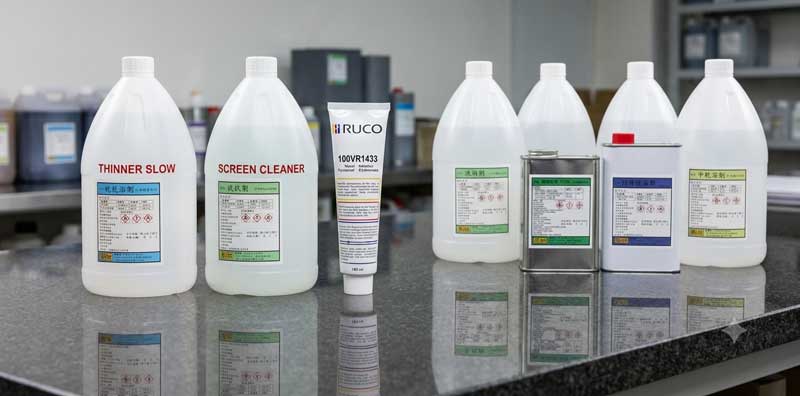
Solvents and Printing: A Guide to Ink Drying Speed and Process Mixing for Pad & Screen Printing
In industrial printing processes, choosing the correct industrial solvents and printing auxiliaries is a key technology determining pad and screen printing quality. FINE CAUSE has compiled this "Guide to Specifications and Effects of Industrial Solvents and Printing Additives" to help technicians quickly cross-reference process settings such as screen cleaning, pad printing plate depth, ink dilution, and screen clogging prevention.
I. Specifications of Cleaning and Diluting Solvents for Screen/Pad Printing
Choose the corresponding specialized solvent based on the printing method, plate depth, and drying speed requirements:
| Product Name | Application, Effect, and Technical Specifications |
|---|---|
| Cleaning Solvent | Suitable for screen and plate cleaning; quickly removes residual ink. |
| Wiping Solvent | Usually used for wiping product surfaces in case of defective printing. The key feature is that wiping will not damage plastic surfaces such as ABS, PC, and Acrylic. |
| Super Fast-Drying Solvent | Usually used for diluting pad printing inks. Significantly accelerates ink evaporation and enhances pad ink release effects. |
| Fast-Drying Solvent | Suitable for inkwell pad printing (open inkwell systems).
|
| Medium-Drying Solvent | Suitable for inkwell pad printing when the pad printing plate depth is between 15µ ~ 22µ. |
| Slow-Drying Solvent | Suitable for general screen printing, or halftone pad printing with a plate depth of approximately 15µ. |
| Super Slow-Drying (Anti-Clogging Agent) | Suitable for screen printing. Added when ink dries too quickly or when fine printing lines cause screen clogging. |
II. High-End Functional Additives for Screen/Pad Printing Inks (Defoaming, Viscosity Reduction, Anti-Spreading)
For high-precision and fine-pattern printing, the physical properties of the ink can be adjusted using the following functional auxiliaries:
| Product Name | Professional Mixing Guides and Technical Features |
|---|---|
| Slow-Drying Paste (Retarder Paste) Available in HM (Imported) and Taiwan-made types |
A grease-like paste mainly used to prevent ink from spreading too quickly during the screen printing process.
|
| ST1 Viscosity Reducer | Suitable for both pad and screen printing. Mainly used to reduce ink viscosity to effectively prevent cobwebbing during printing. Mixing Ratio: Recommended ratio is approximately 10%. |
| VM1 Leveling Defoamer | Suitable for both pad and screen printing. Increases ink fluidity, making it difficult for ink to foam under high-speed printing or unfavorable weather conditions (such as high humidity and high temperature), and features self-defoaming capabilities.
|

