
 0
0



- Home
- Knowledge
- Printing Selection Guide
- How to Choose Between Pad Printing and Screen Printing?
How to Choose Between Pad Printing and Screen Printing?
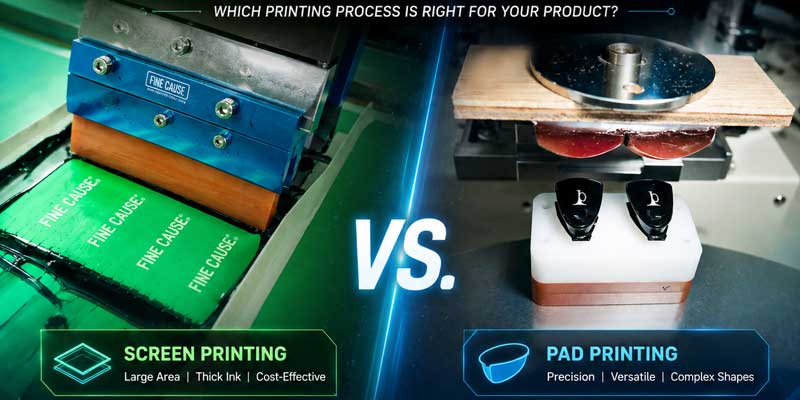
Printing Method Selection - Choosing Pad Printing or Screen Printing?
When selecting a printing process, pad printing and screen printing are two common techniques, each with its unique advantages suitable for different printing needs. The choice of method primarily depends on the following factors: the material of the object being printed, its shape, the size and thickness of the printed graphics, and other specific requirements.
■ Material of the Object Being Printed
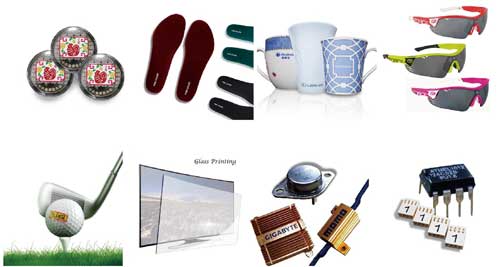
Both pad printing and screen printing can be applied to a wide range of materials, including plastic, metal, ceramic, glass, rubber, paper, and fabric. This means that when choosing a process, the substrate material is generally not a limiting factor.
■ Shape of the Object Being Printed
Pad printing, with its flexible silicone pad, can print on objects of various shapes, including flat, concave, convex, curved, and irregular surfaces. Therefore, pad printing is especially suitable for objects with complex shapes or irregular surface textures. In contrast, screen printing is more suitable for flat and simple curved surfaces, such as cylindrical or conical shapes.
■ Size of the Printed Graphics
In general, pad printing is better suited for fine, small graphic printing because it can accurately reproduce intricate details. On the other hand, screen printing excels in larger graphic printing and can even handle graphic content up to 100 to 200 cm, making it a better choice for large-area printing.
■ Thickness of the Printed Graphics
In terms of printing thickness, pad printing usually deposits a thinner layer, with the dried ink thickness typically below 0.01 mm. Conversely, screen printing offers greater control over thickness, allowing adjustments through the screen mesh count/thickness and the hardness of the squeegee. Therefore, if there are specific requirements for a thick ink layer, screen printing might be more suitable.
■ Other Characteristics
Pad printing utilizes fast-drying inks, making it especially advantageous for multi-color wet-on-wet printing. Screen printing offers more variety in ink selection, including not only solvent-evaporation inks but also UV inks, conductive adhesives, chemicals, and even thermal paste. Additionally, screen printing plates are often more economical to produce compared to pad printing plates for large-format designs.
[Click here for recommended pad printing inks]
[Click here for recommended screen printing inks]
■ Summary
When choosing between pad printing and screen printing, it's essential to evaluate based on the material, shape, size, and thickness of the printed graphics, as well as specific industrial demands. If you need to print on irregular surfaces or require high-definition fine graphic printing, pad printing is the ideal choice; for large-area printing or tasks requiring thickness control, screen printing has a distinct advantage.
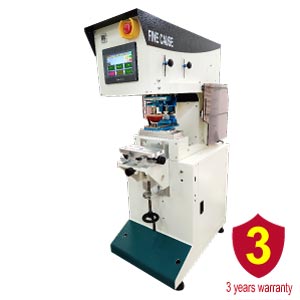
For beginners or low-volume production, contract pad printing is recommended.
Want to Print In-House? Recommended ANC Series Sealed Ink Cup Pad Printer
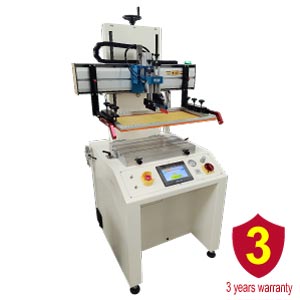
For beginners or low-volume production, contract screen printing is recommended.

Want to Print In-House? Recommended Screen Printer: TSN Series (Servo-Driven)
Comparison Table of Pad Printing and Screen Printing Characteristics
| Comparison Feature | Pad Printing Characteristics | Screen Printing Characteristics |
|---|---|---|
| Substrate Material | Plastic, Metal, Ceramic, Glass, Rubber, Paper, Fabric, etc. | Plastic, Metal, Ceramic, Glass, Rubber, Paper, Fabric, etc. |
| Substrate Shape | Flat, Concave, Convex, Curved, Irregular Surfaces, Textured Surfaces | Flat, Simple Curved Shapes (Cylinder, Cone) |
| Printed Pattern & Size |
|
|
| Ink Layer Thickness | Thinner ink deposition. The dried pattern thickness is typically less than 0.01 mm. | Thicker ink deposition. Thickness can be precisely controlled by screen mesh count and squeegee hardness. |
| Other Key Features |
|
|
